What a Window Seat Lets You Notice
A carriage window turns a journey into a sequence of clues: cuttings, field boundaries, station edges and the settlements gathered around the railway.
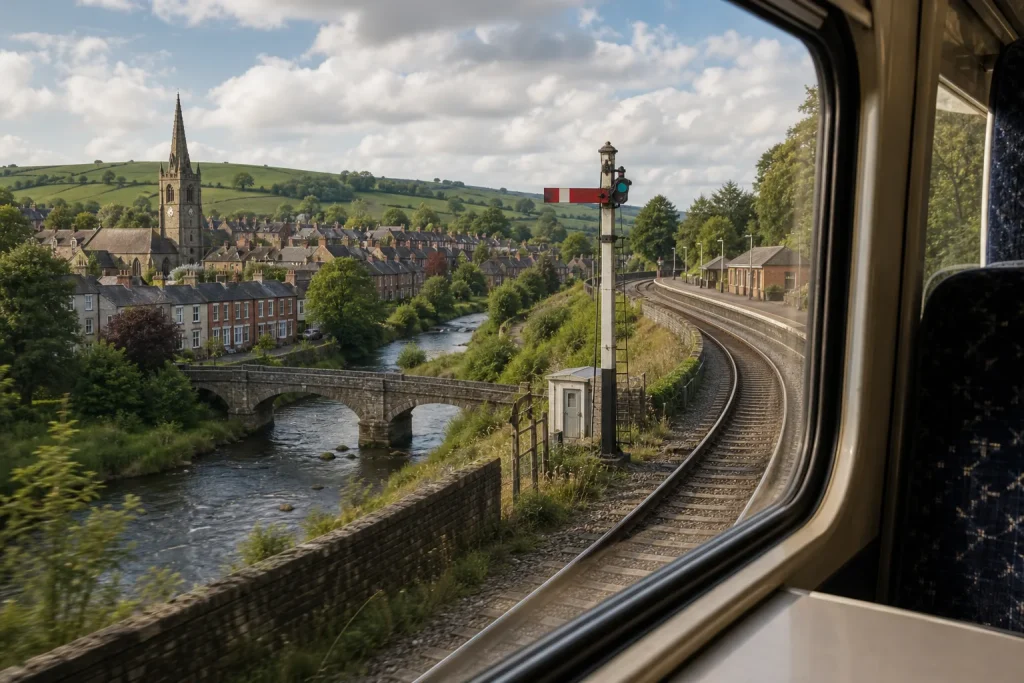
A window seat makes the railway’s route legible. Watch how a hill is cut, where a village gathers, and what changes beside the track; the landscape becomes a sequence of decisions rather than a blur between stations. You do not need a map for every mile. A little attention, and a reasonably clean window, will do.
Read the ground
Start with the shape of the land. A train climbing through open country may run beside a slope, then slip into a cutting where the railway has been lowered through a ridge. The exposed sides can show layers of soil and stone. In a deep cutting, trees may appear close to the carriage, while the fields above vanish from view.
Notice when the line takes the easier contour instead of crossing directly over a rise. Curves often reveal that the railway is following a valley or avoiding steep ground. A river may appear and disappear beside the track; its bends can explain the route better than the timetable does. If the water is on one side for a while and then crosses beneath the train, look for a bridge or a culvert in the next stretch.
Embankments tell the opposite story from cuttings. The train is lifted above the surrounding ground, sometimes to cross wet land or keep the track on a steady level. From the window, the view may open suddenly over roofs, allotments or a marshy field. Then the raised line drops back towards the landscape it has been skirting.
It is not worth trying to identify every geological feature at speed. Choose one change in the ground and follow it for a few minutes. A slope that grows gentler, a stream that turns away, or a line of trees marking a ridge is enough to make the route distinct.
Follow the settlement
Buildings gather around railways in patterns. Older town centres may sit at some remove from the station, while later streets extend towards it. At the edge of a place, look for terraces, warehouses, sidings or a broad road that runs parallel to the line. These often mark the railway’s working relationship with the town, even when the original railway buildings have changed use.
Small stations offer especially clear views of settlement edges. A platform may face allotments or gardens on one side and a compact high street on the other. Beyond the last houses, fields begin abruptly, or a newer estate makes a softer transition. Keep an eye on how that boundary shifts as the train moves: the town may follow a river, a main road or the railway itself.
Say you are travelling through a fictional market town called Merefield. You notice a church tower above the centre, then a row of brick workshops beside the track, followed by gardens and open fields. If the train later passes a river bridge and the settlement reappears on the far bank, you can infer that the town grew along both the water and the railway corridor. That is a useful reading of the view, not a claim about any real place.
Look, too, for what is absent. A wide gap between the station and the main street might mean the railway was built outside the old centre. A station set among houses may have drawn development towards it. The window supplies clues; a local map can settle the question later, if settling it matters.
Notice railway marks
Railway features are easiest to see when you stop treating them as background. A signal post, a lineside hut or a row of overhead wires gives the eye a scale and direction. On electrified routes, masts and wires recur at measured intervals. Their steady rhythm can make a straight stretch feel even longer, while a bend briefly gathers them into a dense line.
Bridges reveal how the railway negotiates other routes. A road passing underneath may be carried through a stone or brick arch; a newer structure may use concrete and clean, broad spans. Watch for a change in the wall beside the track as the train approaches. It may rise into a bridge parapet, then fall away after the crossing.
Level crossings, where visible, show the railway meeting local movement at ground level. Elsewhere, a footbridge or underpass keeps people and trains apart. Look for paths that end at a fence, then resume on the far side. The interruption is a small reminder that railway infrastructure reorganises ordinary journeys, not only long-distance ones.
Trackside signs flash past quickly, so there is little profit in trying to read every one. Instead, notice their placement: a signal before a junction, a marker beside a curve, or a change in equipment where the line enters a station. The pattern matters more than the wording.
Use the pauses
Stations give the eye time to compare the view with what came before. From the platform, note which side has the town, the river or the open fields. When the train leaves, watch how quickly the buildings thin out. A short stop can make a boundary visible that would otherwise pass in a rush.
Keep the window view simple. Choose one subject for a stretch: landform, settlement or railway feature. When it disappears, choose another. This is less tiring than trying to catalogue everything, and it prevents the landscape from becoming a collection of half-seen roofs and telegraph poles.
If glare obscures the view, shift your angle or lower the window blind if the carriage has one. Avoid pressing a camera lens against the glass; reflections and vibration usually make the result less useful than a quiet look. A small notebook can help, but a few place names and plain descriptions are enough: “low ridge, stone bridge, houses near station”. No sketchbook worthy of a railway poster is required.
Let the sequence guide you
The most revealing observation is often a transition. Open fields become a cutting; a river valley narrows; houses gather around a station and then recede. Note what changes first and what follows. If woodland appears before the ground rises, or industrial buildings before a river crossing, those details help you remember the route as a connected landscape.
Use the timetable or route map only when it adds something. A map can identify a river or show why the line curves, but looking up every feature interrupts the view. Let uncertainty remain where it is harmless. The train will carry the unanswered question onwards, which is one of the few services it provides without a reservation.
When the scenery grows familiar, look for a small difference: a new field boundary, a row of houses ending at a footpath, or a railway bridge changing from brick to steel. These details make even a repeated journey readable. The window does not provide the whole story, but it gives you enough to notice how the railway and the land have made room for one another.
Another stop nearby
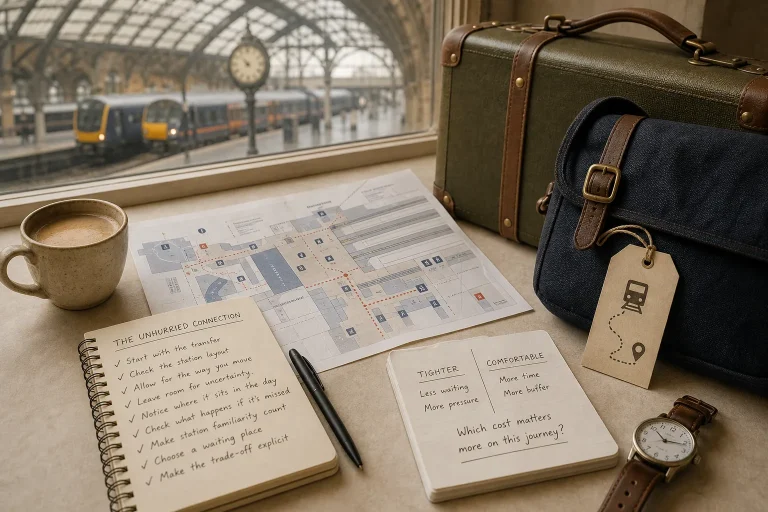
The Unhurried Connection: Leaving Space Between Trains
A comfortable rail connection is not simply a long wait. Match the gap to the station,…
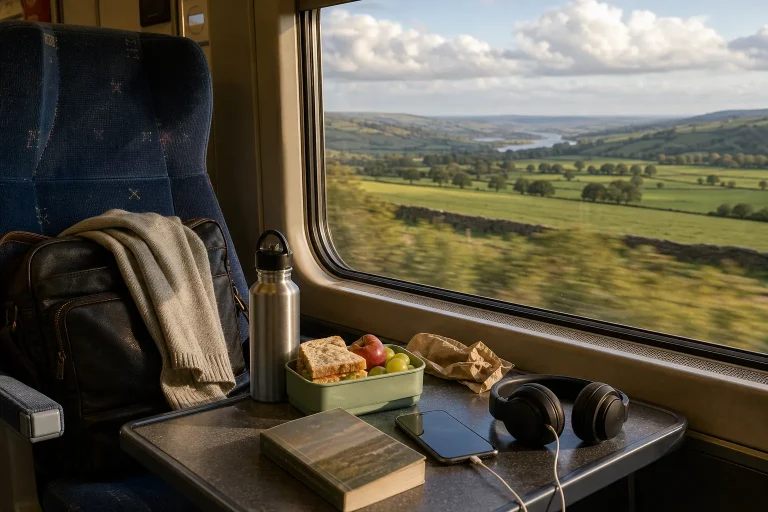
A Long Ride Without a Packed Schedule
A fictional journey shows how a few gentle anchors—food, rest and looking out—can give a long…