The Unhurried Connection: Leaving Space Between Trains
A comfortable rail connection is not simply a long wait. Match the gap to the station, the transfer and the kind of day you want to have.
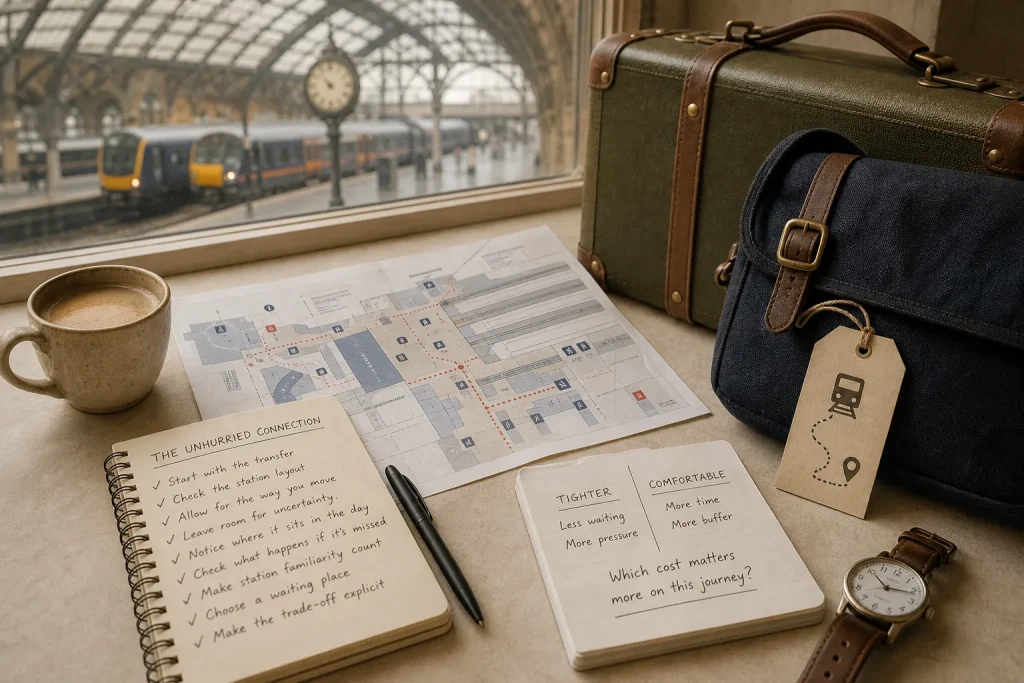
A connection that looks generous on a timetable can feel hurried if it involves a station change, while a shorter pause in a familiar concourse may be perfectly manageable. The useful question is not how long you can wait, but what the transfer asks of you. A little planning around the station, the route between platforms and your tolerance for uncertainty can turn a fragile itinerary into a calmer one.
Use these decisions to judge the space between trains. They are not rules for every journey: rail services, ticket conditions and station layouts vary, so check the current details before you book.
Start with the transfer
- Identify what must happen between trains. A same-platform change is different from crossing a concourse, using lifts, passing through ticket gates or walking to another station. Read the itinerary closely rather than treating every interchange as a simple platform swap. If the booking names two stations in the same city, check whether they are actually connected or merely nearby on a map. A transfer on foot through unfamiliar streets needs more thought than one inside a single station.
- Check the station’s own layout. Look at an official station map or the operator’s station information. Note where the platforms, entrances, lifts, toilets and ticket gates sit in relation to one another. A station can have a compact main hall and still require a lengthy route to a distant platform. If you use a mobility aid, travel with substantial luggage or simply prefer to avoid stairs, check step-free routes and lift access directly. A map helps with orientation; it does not tell you whether a lift is operating on the day.
- Allow for the way you move. Timetables do not carry bags, find signs or make room for a slower walking pace. Think honestly about what you will have with you and whether you are content to hurry. Someone travelling light and familiar with the station may choose a tighter connection than someone arriving with a folded pushchair, a large case or a tired companion. Neither choice is more virtuous. The aim is to plan for the travellers who are actually going, rather than an imaginary fleet-footed version of them.
- Separate the scheduled gap from the usable gap. The interval printed between arrivals and departures is not necessarily all available for a relaxed change. The first train may arrive late, or the platform may be announced close to departure. If the next train is important, leave room for ordinary uncertainty rather than assuming both services will behave like tidy lines on a screen. Check the operator’s guidance on connections and missed trains, especially if the journey uses separate tickets. Ticket conditions can affect what help is available if a service is disrupted.
- Notice where the connection sits in the day. A tight change after a short local journey may feel different from one after several hours aboard. Consider whether you will need food, a drink, a toilet stop or a chance to stretch before boarding again. If the onward train is the last practical service for your destination, a missed connection may have more serious consequences than a delay earlier in the day. The same transfer time can therefore be reasonable in one itinerary and uncomfortable in another.
- Check the consequences of missing it. Look at what happens if the incoming service runs late. Is there another train, and would your ticket be valid on it? Does your route rely on a booked reservation, a separate operator or a final service of the day? The answer may depend on the ticket and the disruption, so consult the relevant operator or retailer rather than relying on a general assumption. If the onward service is infrequent or alternatives are poor, a longer connection can be useful insurance, though it cannot remove every risk.
- Make station familiarity count. If you know the station, you may already understand which entrance is closest, where the platforms sit and which signs to follow. For an unfamiliar interchange, study the map before travelling and note the names of both stations if a change of location is involved. A quick look at the layout can prevent the classic error of following “Exit” when you meant “Platform 6”. There is no need to memorise every shop and corridor. A rough sense of direction is enough.
- Choose a waiting place, not only a waiting time. A longer pause is easier to accept if you know where you can sit, get a drink or wait indoors. Check station facilities and opening information where these matter to your plans; not every facility is available at all hours. If the station is small or quiet, consider whether you would rather wait in a nearby staffed café or remain close to the platforms. Keep your train information handy and leave time to return to the correct platform without turning a pleasant pause into a dash.
- Make the trade-off explicit. A tight connection can shorten the day and reduce time spent waiting, but it asks you to accept more pressure. A longer gap uses more of the day, yet may allow a meal, a walk around the station or a buffer for delays. Decide which cost matters more on this particular journey. Do not add a long stop simply because “more time” sounds safer; a connection is useful only if the extra time improves the day or meaningfully reduces a risk you care about.
- Use a realistic worked plan. Say you are changing at an unfamiliar city station, carrying a suitcase and travelling on to a destination with limited later services. You check the official map, see that the platforms require a walk through the main concourse, then confirm the ticket’s disruption terms and the onward service pattern. You choose an itinerary with a more comfortable gap and plan to wait near the departure boards after arriving. The expected result is not certainty: it is a transfer with less rushing and a clearer next move if the incoming train is delayed.
Skip false precision
It is not worth timing every corridor from a map or trying to predict a precise walking pace from a station diagram. Crowd levels, works and platform changes can alter the route, and a neat calculation may create confidence without adding much protection. Focus instead on the features that change the decision: whether the station is unfamiliar, whether you must change location, whether step-free access matters, how frequent the onward service is and what your ticket allows after disruption.
For a same-station change, check the operator’s recommended connection information and decide whether the walk suits your circumstances. For a change between stations, treat the transfer as a small journey of its own: identify the route, check how you will travel between them and allow for the possibility that things take longer than the map suggests. If the journey is essential and the consequences of missing a connection would be significant, ask the operator or a qualified travel adviser about the specific ticket and route rather than relying on a broad rule.
Keep the margin useful
Extra time works best when it has a purpose. It might give you room to find the right platform, eat before a long onward ride or absorb a delay without running. If none of those matters and the station is familiar, a shorter connection may suit you. If several uncertainties stack up, space between trains can be the difference between arriving alert and spending the journey watching the departure board in your head.
Before booking, compare the full route rather than the connection alone: station layout, access needs, ticket conditions, alternative services and the shape of the day. Then choose the gap you can live with. A calm itinerary is not one that eliminates uncertainty; it is one that leaves you with a sensible next move when the railway declines to follow the neat version.
Another stop nearby
A Long Ride Without a Packed Schedule
A fictional journey shows how a few gentle anchors—food, rest and looking out—can give a long…
What a Window Seat Lets You Notice
A carriage window turns a journey into a sequence of clues: cuttings, field boundaries, station edges…