A Long Ride Without a Packed Schedule
A fictional journey shows how a few gentle anchors—food, rest and looking out—can give a long train ride shape without turning it into a timetable of its own.
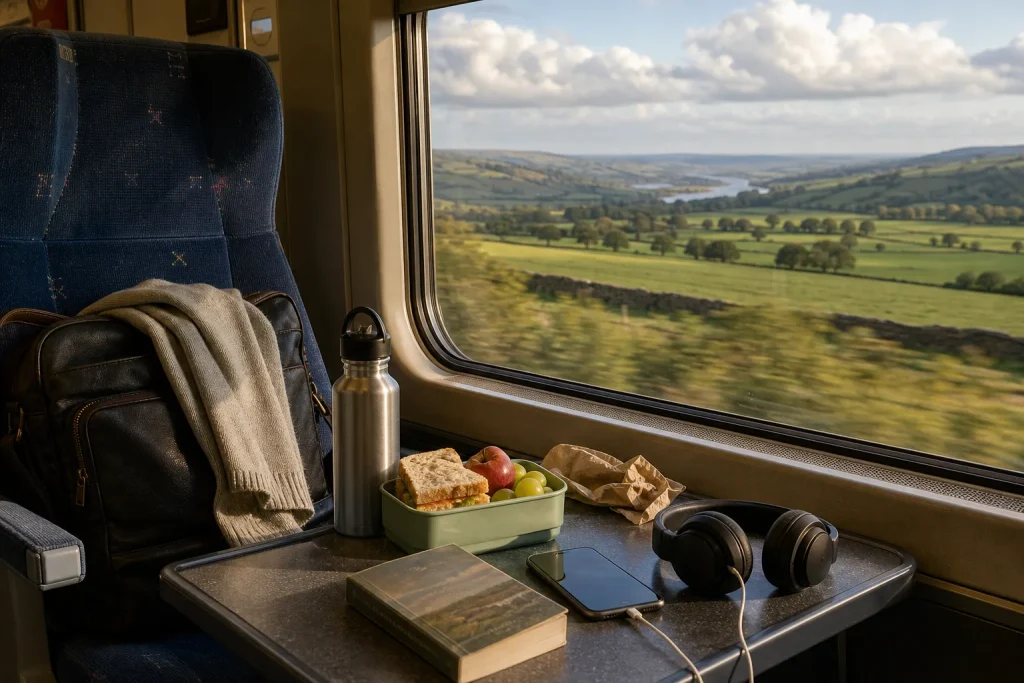
On a long train ride, a packed schedule can make the hours feel smaller and less pleasant. Imagine you are travelling from Edinburgh to Penzance, with a change at London Paddington, and have most of a day to spend on the move. The train offers a seat, a window and a sequence of landscapes; it does not require you to convert every stretch into an activity. A few loose anchors are enough to make the journey feel cared for.
This is an invented situation, not a report of a real trip. Its useful question is simple: how might you arrange the day so that rest, basic comforts and attention to the view each have room, without assigning them a slot on a minute-by-minute plan?
A loose starting point
Say you are travelling alone, with a small bag, a reserved window seat and a connection at Paddington. You have packed a sandwich, a piece of fruit, a refillable water bottle, a light jumper and a book. Your phone has a charger and headphones. None of this is elaborate. The bag is arranged so that the things you might want in your seat pocket or on your lap are easy to reach, while the rest can stay put.
Before leaving home, you check the booked service, the change at Paddington and any information from the operator. That is the practical frame, not a demand to keep checking the clock. You know where the transfer sits in the journey and roughly how much time it allows. During the ride, the train’s live information and station announcements are the sensible sources for changes. If something shifts, you can respond to the new situation rather than following a plan that has already expired.
It helps to decide on a few broad intentions. Eat before getting too hungry. Take a break from reading if your eyes or head feel tired. Look out when the landscape changes or catches your attention. These are prompts, not appointments. If the train is crowded or the view is hidden by rain, the day need not be rescued by adding more tasks.
Settling into the seat
At the start, you put the coat and larger bag away, keep the water and food accessible, and adjust the seat as comfortably as the carriage allows. You check the route display and settle your phone on charge. Then you let the first part of the ride be ordinary. There is no need to begin with a notebook, a playlist and an ambitious reading target. A train journey is not improved by treating the seat like a small office with worse table space.
For a while, you read. When the carriage gets louder, you put the book away and listen to music at a modest volume, keeping enough awareness of announcements. Later, you remove the headphones. The point is not to alternate activities according to a formula. It is to notice when one thing has stopped being comfortable and choose another that asks less of you.
Long stretches can make people feel they ought to be productive. That impulse is not especially useful here. You could answer messages, sort photographs or plan the next week, but the journey already has its own simple structure: stations arrive, fields and towns pass, and the light changes. If a practical message needs a reply, send it. There is no particular virtue in turning the rest of the ride into an inbox with upholstery.
Food without ceremony
As the morning passes, you eat the sandwich and fruit when you are ready rather than waiting for a formal meal break. The water bottle stays within reach. A napkin and a small bag for rubbish keep the seat area tidy; any food packaging can go in the appropriate bin when one is available. If the train has a buffet or trolley service, you can use it if convenient, but you need not rely on it as the only plan.
Simple food is useful because it reduces decisions. You do not need a complicated picnic that occupies the table or leaves crumbs in every seam. A sandwich, fruit and a drink are enough to make the middle of the journey less dependent on what happens to be for sale. If you have dietary needs or other requirements, plan around what you can comfortably eat and carry, and check the operator’s guidance where relevant.
In this invented case, you notice that eating at the first convenient moment works better than trying to time a meal precisely. The carriage may be busy later, or the table may be needed for another passenger’s belongings. That is not a reason for elaborate forecasting. It is a reminder that a long ride contains ordinary opportunities, and a small amount of readiness makes use of them.
Rest without rules
After food, you close the book and rest. Perhaps you lean back and look through the window; perhaps you close your eyes for a while. The light jumper makes the carriage feel more comfortable if the air is cool. You keep your bag and valuables secure and avoid leaving anything in the aisle. If the seat does not recline or the carriage is restless, resting can mean doing less rather than sleeping.
There is no requirement to nap, and no prize for remaining alert through every mile. A long journey gives you permission to be quiet, but not to ignore the practicalities around you. Keep an ear open for announcements and know which station is next, especially if you are approaching a change. If you use headphones, keep the volume low enough to hear important information, or pause them when the train nears the connection.
In the imagined journey, you wake—or simply look up—from a spell of rest to find the view has changed from open fields to the built edge of a city. That shift is enough to draw your attention. You have not missed a prescribed activity, because there was none. Rest did not take you away from the journey; it gave the next stretch a fresh beginning.
Letting the view lead
After the city, you put the book aside and watch the land outside. Attention need not mean naming every station or identifying every tree. You might notice the movement from dense housing to allotments, then to wider fields; a river beside the line; warehouses giving way to gardens; the way a cutting briefly narrows the sky. These are small observations, not a test of railway geography.
A notebook can be useful if you enjoy recording a phrase or a place name, but it is optional. You could jot down the station where the landscape opens out, or simply watch until it changes again. A phone camera may be tempting, though photographing through glass often produces reflections and blur. Take a picture if you want one; there is little point in spending half the ride correcting an image that the passing view has already replaced.
Imagine you pass a broad estuary while the sky is low and pale. You close the book, move the water bottle aside and watch the banks and boats slide past. The observable result is not a grand revelation. You have seen a stretch of the route clearly enough to remember its shape, and you have not had to turn it into a project. That is plenty.
Keeping the change simple
As Paddington approaches, the journey’s loose rhythm gives way to a practical task. You check the current platform information, gather your belongings and make sure the rubbish is dealt with. Before leaving the seat, look around for your phone, charger, book and bottle. At the station, follow the signs and announcements for the onward train. If the service has changed or the connection is unclear, ask staff rather than relying on a guess.
The change is part of the day, but it need not become a new schedule of miniature errands. You have one clear priority: reach the right onward service with your belongings. If time allows, you can refill the bottle or buy food. If it does not, those extras can wait. The invented traveller reaches the platform with the essentials gathered and enough attention left to board calmly. The result comes from keeping the task narrow, not from trying to optimise every pause.
For passengers who need assistance or have particular mobility, health or access requirements, it is sensible to arrange support in advance through the relevant operator and confirm the details before travel. A loose approach to leisure does not mean being casual about a connection or access need. It means distinguishing the things that merit preparation from the hours that do not need micromanaging.
What the day needs
By the time the train continues west, the original arrangement has not been followed like a timetable. You have eaten, rested, read for a while and watched the view. Perhaps the order was different from what you expected. Perhaps the carriage was noisy, the light poor or the book more absorbing than anticipated. The useful part was having options within reach, not enforcing a particular sequence.
For your own long ride, prepare the few comforts that matter to you: water, food you can carry, a warm layer, something to read or listen to, and the details needed for any connection. Keep them accessible. Leave the rest of the day open enough to respond to tiredness, appetite and changing scenery. There is no need to pack a second bag of diversions in case you fail to enjoy the first one.
The most useful lesson from this fictional journey is modest: give the ride a frame, then allow the hours to fill themselves. A train seat can be a place to eat, doze, read, watch or sit quietly without requiring each activity to justify its presence. When the landscape offers something, look. When it does not, rest. The journey will continue without your supervision, which is one of its better arrangements.
Another stop nearby
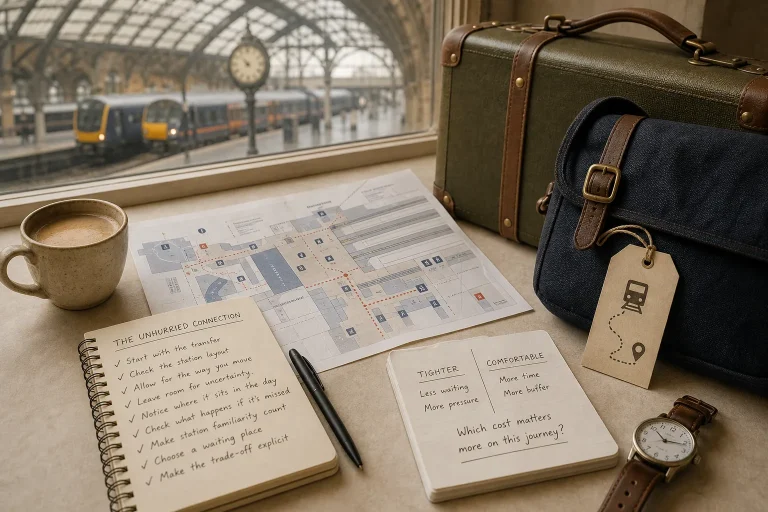
The Unhurried Connection: Leaving Space Between Trains
A comfortable rail connection is not simply a long wait. Match the gap to the station,…
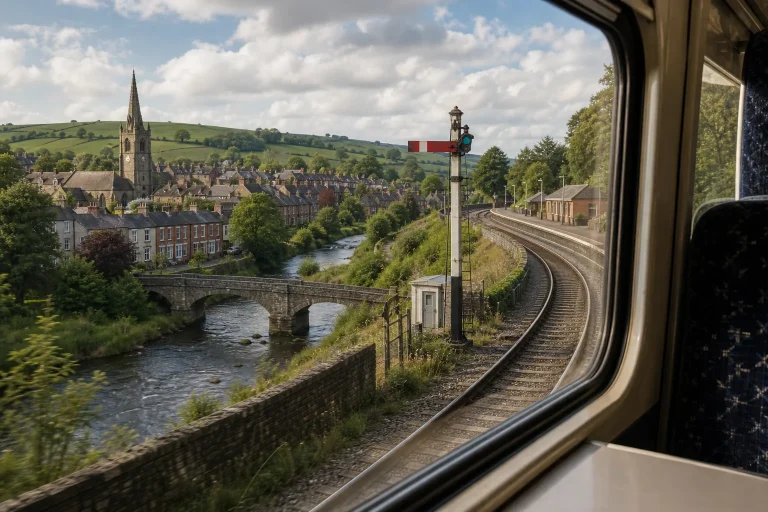
What a Window Seat Lets You Notice
A carriage window turns a journey into a sequence of clues: cuttings, field boundaries, station edges…